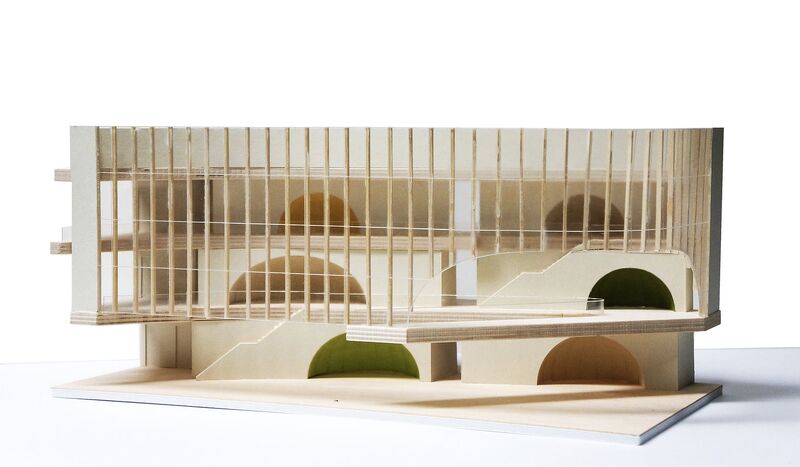
AI has started to eliminate a lot of tedious, manual, messy work. But I’ve started to wonder if that’s actually a blessing for us humans. It reminds me of my first job out of college as an architectural designer.
My regular work hours were 8:40am to 10:30pm, which often stretched to 11:30pm or midnight. I worked every other Saturday. And 90% of the time, it was because of the physical models of the buildings we were designing. It is an extremely time-consuming thing to do. At the time, I almost became sick of making physical models and was always frustrated, asking, “Why the heck do we need to do this when we can easily model + render everything in 3D? This is so stupid.”
More than 10 years later, I’m not even in the architecture/design field anymore. But I’ve finally started to appreciate why physical models were so important.
You can model a building much more quickly in 3D as a collection of solid objects, but you tend to overlook how those objects are actually put together under real gravity. And digital 3D isn’t even truly “3D.” Essentially, you’re still looking at 2D images; digital geometry just allows you to capture images of the object from different perspectives in real time.
Physical modeling, on the other hand, exposes you to the messy, tedious, manual, and boring process of actually “building” things with your own hands under real physical constraints. During that tedious process, you silently develop an understanding of the nuances of how different materials join together. You also get to see the real 3D object—something that can’t be embellished by digital techniques. You experience the “raw” nature of its physical presence.
Coming back to AI: I think this is exactly what I'm realizing in knowledge work. Some of the things we consider boring, tedious, wasteful, and time-consuming might actually strengthen our mental muscles at a fundamental level. Reading texts to find information. Reading numbers in a table to identify patterns. Finding cohesive insights across different data sources. Writing code to arrive at the right logic; These are the things that make our brains stronger and force us to develop “intuition” and “instinct” by repeating them over and over again.
People in tech say these days, “Building products has gotten cheaper because of AI. What matters now is having the instinct and intuition to decide the right thing to build.”
That is true.
But we may also be taking away opportunities to develop those instincts by eliminating all the tedious mental work humans have been doing for generations.
Well, I’ll still be looking for ways to optimize business processes with AI tomorrow. But I’m also starting to think more seriously about how to protect my brain from becoming overly reliant on it. I believe a sharp instinct can only be developed the hard way.